
About his work
The work of José Emilio Fuentes Fonseca, known as JEFF, possesses a startling singularity within contemporary Cuban art. It doesn't align with any of the dominant movements that typically favor a critical engagement with their contexts—whether expressed through a multitude of media and their intersections, or those that prioritize formal revisitations of historical trends (like abstraction, surrealism, expressionism, Transavanguardia, or Pop Art) as a demonstration of technical skill, critical appropriation, and maturity.
Nor does he exploit the ample advantages offered to artists today by Conceptualism or Minimalism, either by adhering strictly to their original form or to the version (to swell the long and sometimes overwhelming "neo" list) imbued with contextual subtleties, humor, irony, parody, and adapted to the most diverse existing cultural settings thanks to its instrumental versatility. Significantly, if not astonishingly, he excludes photography and video—two other forms recently favored by artists across so many affiliations and generations.
If I had to summarize his poetics based on his closest interests, affinities, and intentions—in an attempt to better understand his worldview—I would, immediately and without abandoning lingering suspicions and doubts, label it as "naïf." His works certainly possess a strong current of innocence, candor, and idealism. But a word of caution: this doesn't stem from an academic background or a unique personal experience, nor from an explicit desire to control codes assimilated during childhood. Instead, it arises from an almost natural, organic embrace of that universe vividly expressed by children—sincerely stripped of tricks, winks, falsehoods, artifice, arrogance, sarcasm, duplicity, and ambiguity.
When José Lezama Lima was asked why he chose to write in the style for which he is known—why he selected it as his essential language—he replied, more or less: "It's not that I want to, it's that I simply write that way." JEFF creates in this same manner: there is no need to search for an ulterior motive. This, one way or another, defines him as a rare, unique, and incomparable artist, alienated from the artistic environment in which he operates and lives—even if, at a glance, we all recognize the direction of his notorious and prolific symbolic output.
Despite having lived in Buenavista—a neighborhood often categorized as tough and troubled in the northern part of the affluent Miramar, which serves as a rich, environmental prelude to the well-known Marianao and La Lisa areas—JEFF did not choose to illuminate his work with its complex social and cultural values, its public and secret codes, or its mysteries (to use a word as immense as Gabrielle d’Annunzio would write it), in order to produce work contaminated by violence, bravado, or swagger. No. He knows these categories very well and may even identify with some of them; they are part of his muscle and blood, his imagination. However, they do not sufficiently irrigate his brain and imagination to become a part of his creative language and turn him into a "tough," or in some cases, a marginal or alternative artist. They pass through his nervous system, his emotions, and his feelings, but continue their course toward other regions of his being, allowing him to develop, with serenity and measure, a body of work that is visible to the "good eyes" of friends, curators, artists, critics, and—especially—neighbors, who are astonished by the sheer volume of enormous objects he occasionally displays on the sidewalk of his studio-home due to a lack of interior space.
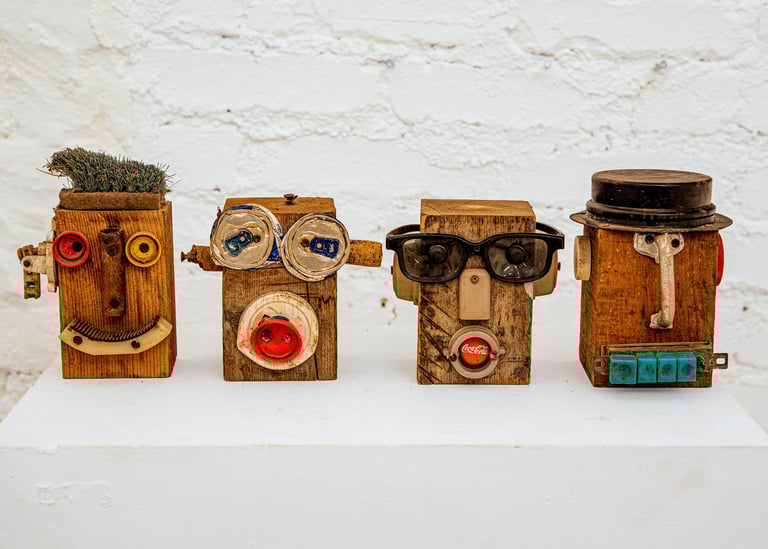
Following a somewhat aggressive, even torn, phase while studying at the ENA and later the ISA in the mid-to-late 90s (during which he was also a member of the Galería DUPP project until 2000), JEFF externalized a significant amount of his fears, nightmares, frustrations, and desires through the creation of various games and toys made from worn iron, spent wood, and generally poor materials. I primarily recall his 1996 exhibition at the Ludwig Foundation, his Painting and Sculpture exhibition at Galería Habana in 2000, and above all, his enormous installation or "children's playground" titled Salud mental (Mental Health), exhibited at the Wifredo Lam Contemporary Art Center as part of the III Cuban Contemporary Art Salon...
After completing his studies at the ISA in 2003, JEFF reversed this dramatically intense psychosocial process, creating works that were almost diametrically opposed. He made a 180-degree turn, setting aside the found object and the explicit will to extensively recycle industrial or artisanal material, and burying, at least temporarily, the Arte Povera aesthetic that had prevailed in his work throughout the 90s and the early 21st century.
Finally the owner of his own home and destiny, and surrounded by affection and like-minded feelings, he decided to change the order of things. Those demons that had appeared galloping from his childhood were cornered—who knows for how long—to make way for a new worldview. Its foundations come from that remote region of childhood, now modeled from a different perspective, perhaps discovering in flagrante his vital impulses and primordial triggers, now filled with gratitude, tenderness, dreams, and aspirations. He transitioned from being the enfant terrible of Cuban art to being a simple child, one among the immense majority, without terrible labels. The only difference is that he persists, now in his adulthood, in keeping alive the emotional and sentimental weight that this fundamental period of our lives carries.
JEFF thus discovered the essential plasticity of innocent, honest graphic expression rooted in school notebooks, diaries, and loose sheets, as well as the undeniable value of the tens and hundreds of objects that populate the imagination and material existence of children. He then set out to reclaim a cultural space he believed had been lost in the experiential clutter of adulthood. He discovered the natural expressiveness of urban graffiti and every mark found anywhere—be it a wall, a tree, or the asphalt—the silent, incorruptible witness to humanity's own fortunes and misfortunes.
Nelson Herrera Ysla